
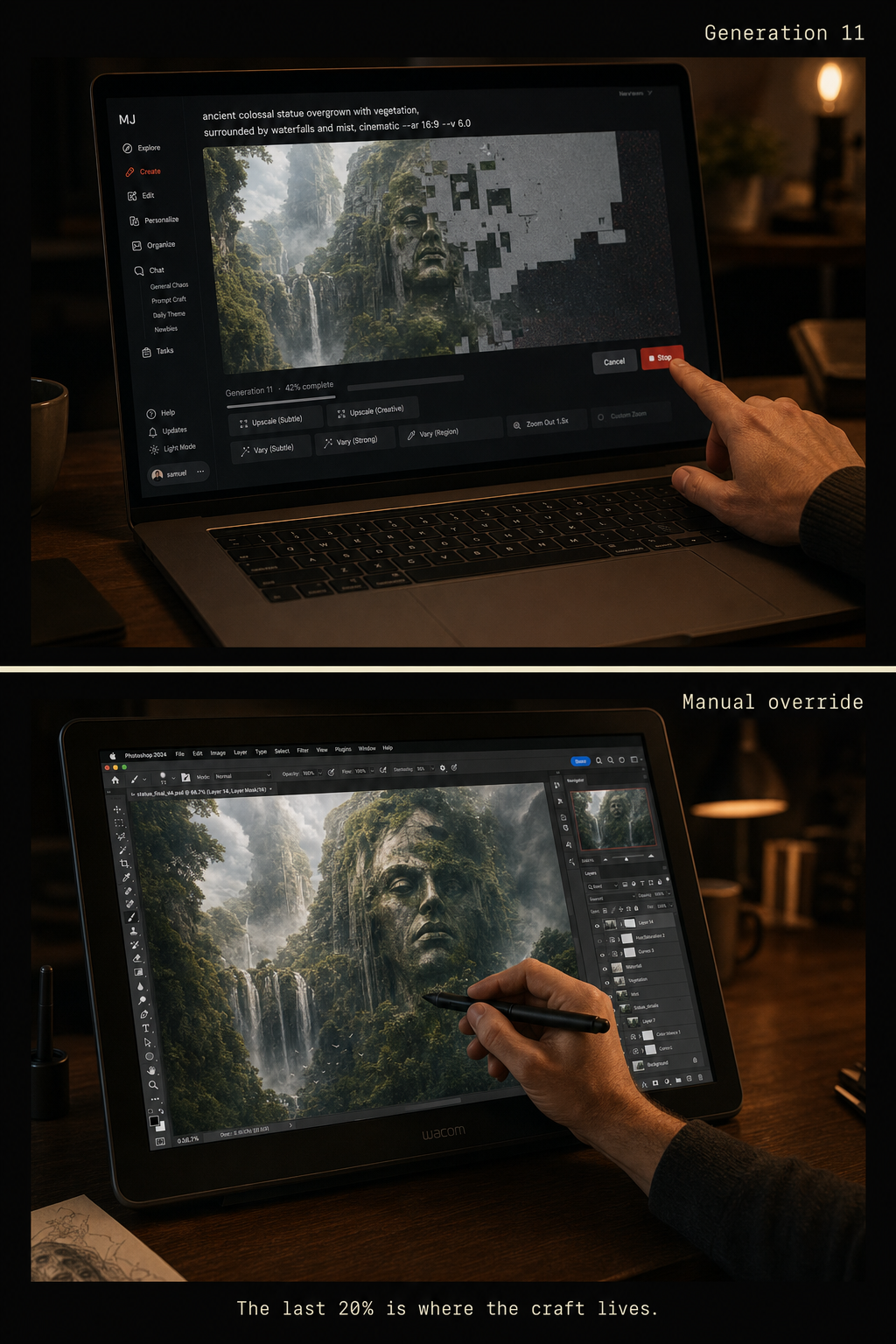
The last 20% is where the craft lives
Every AI workflow has a bail-out point. The moment where you stop trusting the model and switch to manual.
For image generation, mine is usually somewhere between attempt 8 and attempt 12. The output is close. The composition works. The lighting is right. But something's off. The hand grip. The fabric drape. The shadow geometry. The way the cutlery sits on the plate. Small things the model can't quite finish.
That's when I bail. Open Photoshop. Bring in the AI generation as a base layer. Paint over the broken parts. Use the model again for in-painting specific regions. Composite. Color-correct manually. Sometimes shoot the missing element on my iPhone and composite it in.
The final image is maybe 80% AI, 20% manual. But the 20% is what separates production work from generation. It's where the actual skill lives. Anyone can press generate. Far fewer people can look at an AI output and see exactly which 20% needs hand-finishing to ship.
Junior AI users don't have a bail-out point. They keep regenerating, hoping the model gets it right. After twenty attempts they ship the least-broken version. That's why their work looks consistently uncanny.
Senior AI users bail early and finish manually. Their work looks finished because it was finished by a person.
The economics: a fully-AI workflow costs maybe AED 50 in API credits per finished image. A hybrid AI-plus-manual workflow costs AED 50 plus three hours of skilled labor. The hybrid output sells for ten times the all-AI output because clients can tell the difference, even when they can't articulate what they're seeing.
If you outsource AI visual work, ask the practitioner where their bail-out point is and what tools they use after they bail. The answer tells you everything. See how my production runs.