
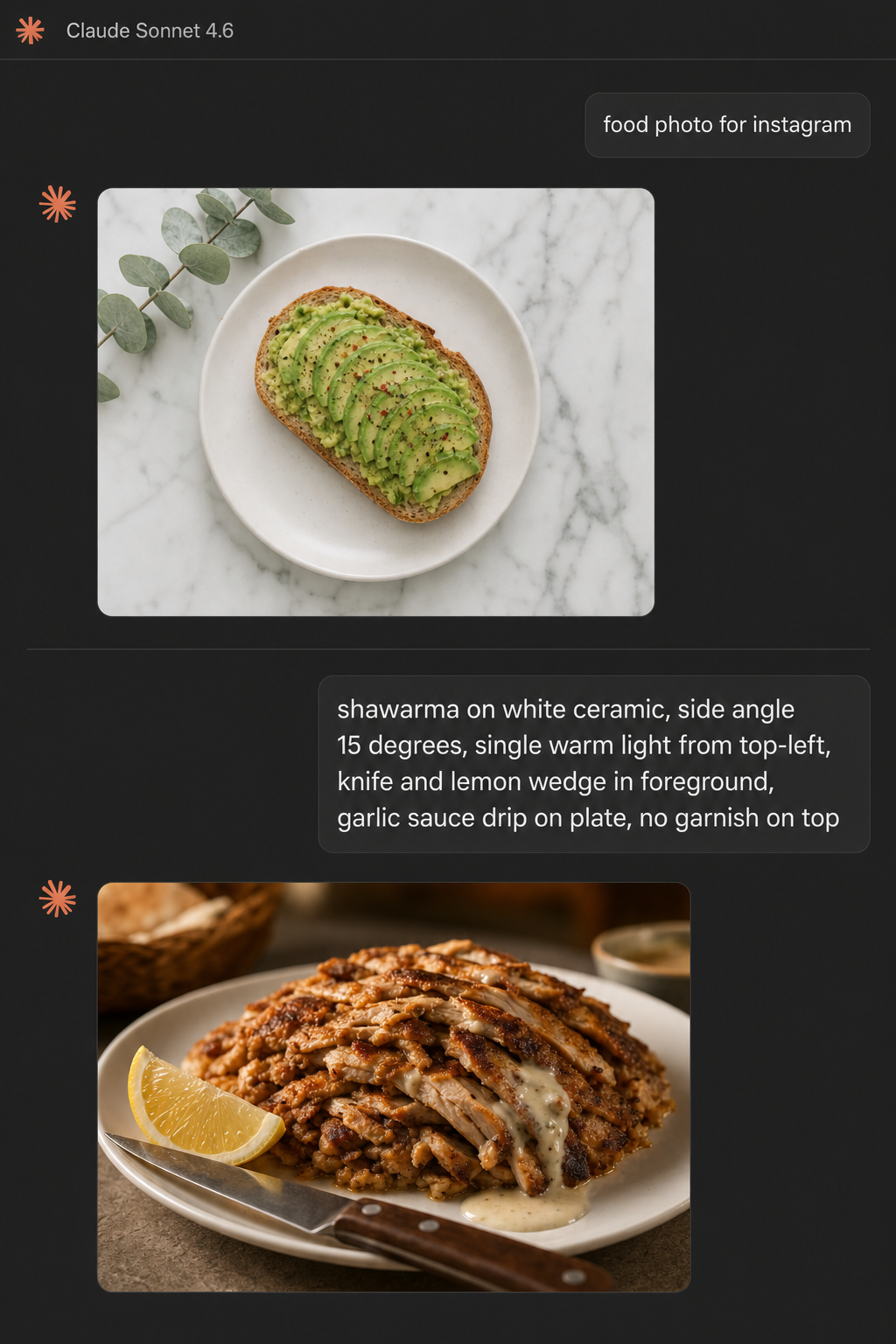
The prompt stack that gets you Talabat-ready food photos
Most "AI food photo" prompts give you the same lazy Instagram aesthetic. Top-down view. White marble surface. Eucalyptus sprig garnish. Soft natural light from a window that doesn't exist.
It's the default the model reaches for because that's what 90% of food photography training data looks like. The vague prompt invites the average. You get an avocado-toast composition no matter what dish you asked for.
The prompt below got me actual Talabat-ready images. The kind that pull orders at the 80×80 pixel thumbnail size where Talabat's interface shows them. Not the kind that look pretty on a desktop preview but vanish in the app.
The stack:
shawarma on white ceramic, side angle 15 degrees,
single warm light from top-left,
shallow depth of field,
knife and lemon wedge in foreground,
garlic sauce drip on plate,
no garnish on top,
photographed for Talabat thumbnail at 80x80px legibility
Why this works:
Specific plate. White ceramic, not "a plate". The default plate the model picks (some textured stone slab) looks artisanal on desktop and reads as visual noise at thumbnail size.
15-degree side angle. Not top-down. Top-down photos lose silhouette at thumbnail size. Side angles preserve "this is a shawarma" instantly.
Single warm light from top-left. Not "natural light". Specific direction means specific shadows, which means depth, which means the dish reads as three-dimensional even at 80 pixels.
Knife and lemon wedge in foreground. Scale cues. Without them, the brain can't tell if it's a kid's portion or a feast.
Garlic sauce drip on plate. The drip is the appetite trigger. Food photographers call it the "wet shot" — it tells the eye "this just got made, this is fresh, this is happening now". Default AI prompts skip it.
"No garnish on top". Defaults add basil, cilantro, microgreens to everything. Real Dubai shawarma doesn't have a basil sprig. Tells the model to skip what it learned from Instagram aesthetic.
"Photographed for Talabat thumbnail at 80x80px legibility". Forces the model to compose for the actual context. Big subject, simple background, clear silhouette.
This is the stack. It works for 80% of menu items as a starting template. The remaining 20% (drinks, desserts, mezze platters) need their own variants — covered in a longer guide.
If you run a Dubai restaurant and your Talabat conversion numbers are flat, your photos are the most likely cause. The new generation of AI photography matches studio quality at a tenth of the cost — but only with the right prompt stack. Get a free menu audit.